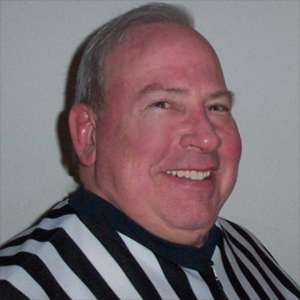
Rndballref
20 Years Experience
Chicago, IL
Male, 60
For twenty years I officiated high school, AAU and park district basketball games, retiring recently. For a few officiating is the focus of their occupation, while for most working as an umpire or basketball referee is an avocation. I started ref'ing to earn beer money during college, but it became a great way to stay connected to the best sports game in the universe. As a spinoff, I wrote a sports-thriller novel loosely based on my referee experiences titled, Advantage Disadvantage
There is no provision for a violation or foul for talking or shouting. There is only one way it might be construed a foul and that is behavior that is considered unsportsmanlike. But to me, shouting "ball, ball, ball" would not rise to the level of unsportsmanlike.
Share Answer: 

Stop the game. Turn the teams around. All points fouls time outs which occurred stand.
Share Answer: 
Foul is on defensive player. Principle of vertical space.
Share Answer: 
You are entitled to your vertical space. If you use your forearm out of your vertical space to seperate the defender it is an offensive player control foul.On the other hand, if your forearm is within your vertical space and the defender pushes your arm away to get closer to you it is a common foul on the defender.
Share Answer: 
Sommelier
 Do you occasionally get a little turned off by wine snobbery?
Hotel Front Desk Agent
 Have you ever had a suicide occur in one of your rooms?
Casino Dealer
 Do you find casinos to be depressing places to work?
No, an offensive player cannot regain the ability to dribble until another player touches the ball WHILE the original player no longer possesses the ball. So if A1 has continuous possession during the time that B1 touches the ball, A1 cannot dribble for the second time. A more likely call is if B1 touches the ball and pushes it in an opposite direction than A1 is holding it, it should be called a held ball (and go to the possession arrow).
Share Answer: 
There is no specific provision in the rule book as to how loud players are allowed to be. It is a judgement call. If I thought it was excessive I would stop the game, warn the coach and warn the players and then start issuing technical fouls. Unfortunately, this behavior might intimidate young players, but at the high school level it probably will not work very well.
Share Answer: 
The referee is supposed to stop play for any immediate danger to a player or eyeglasses and/or contact lens becoming broken or dislodged.
If a player is injured but not in immediate danger and the other team has the ball, the offensive team is allowed to complete the play (finish a drive to the basket, run an attack play). As soon as the offense backs out the ball or stops progressing to a play the ref should stop play to allow the injured player to be tended to.
Share Answer: 
-OR-
 Login with Facebook
 (max 20 characters - letters, numbers, and underscores only. Note that your username is private, and you have the option to choose an alias when asking questions or hosting a Q&A.)
(A valid e-mail address is required. Your e-mail will not be shared with anyone.)
(min 5 characters)
By checking this box, you acknowledge that you have read and agree to Jobstr.com’s Terms and Privacy Policy.
-OR-
Register with Facebook(Don't worry: you'll be able to choose an alias when asking questions or hosting a Q&A.)



 Browse Jobs
 Host a Q&A
 Search

 Submit Your Question
 Host a Q&A
 Last 7

