
Rndballref
20 Years Experience
Chicago, IL
Male, 60
For twenty years I officiated high school, AAU and park district basketball games, retiring recently. For a few officiating is the focus of their occupation, while for most working as an umpire or basketball referee is an avocation. I started ref'ing to earn beer money during college, but it became a great way to stay connected to the best sports game in the universe. As a spinoff, I wrote a sports-thriller novel loosely based on my referee experiences titled, Advantage Disadvantage
The referee is considered part of the floor, so if the player catches the ball with 2 hands after dribbling and bouncing off a referee, it is double dribble.
If this was not the rule then the following could happen:
if a player was trapped with an official nearby, he could bounce the ball off the official and get a new dribble. This is not the intention, so the referee is part of the floor, and a player DOES NOT get a new dribble after bouncing off the ref.
Share Answer: 

If player A1 is in bounds and throws the ball which hits out of bounds player B1 the throw in is awarded to team A.
Share Answer: 
You can stack perpendicular to the throw in boundary line, but if the defense wants to step into a parallel stack room must be made.
Share Answer: 
Unless it has been changed most recently the rule book states, "No logo, marking, lettering, etc. is permitted on the backboard, backboard padding, or basket."
Share Answer: 
School Bus Driver
 Do the kids treat you with the same amount of respect as other authority figures at school?
Football Official
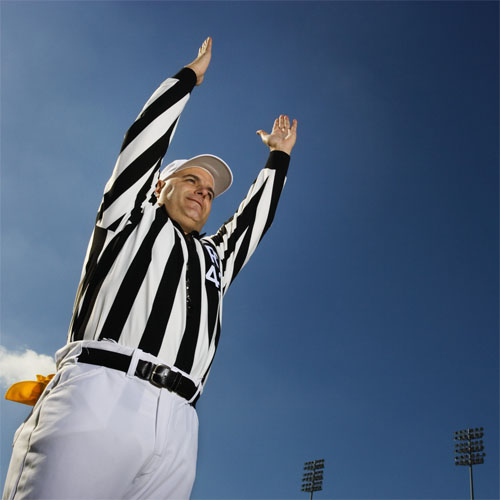 Were the replacement refs actually worse than the regular refs?
CPR Trainer
 Just how effective is the Heimlich, really?
On a spot throw in (as opposed to a throw in after a basket), the in-bounder is required have at least one foot on or above (if jumping) a 3 foot wide area parallel to the boundry line. This same in-bounder can move away from the court until he hits the bleachers, wall or any other obstruction in a perpendicular area to the boundry line as long as he stays within the 3 foot wide area.
Also note that during a throw-in, the in-bounder cannot be called for traveling - that is he can move within the 3 foot area without dribbling.
Share Answer: 
I am not sure about international rules and it does not seem like an in bounder can shoot from out of bounds. I have seen international basketball where the in bounder can retrieve the ball and throw it in without the referee touching the ball. I actually like that way for inbounding after violations because it makes the defense hustle (kind of like a throw in in soccer).
Share Answer: 
It is impossible to say or even generalize/ For example the University of Illinois, a D1 Big Ten school had scholarship player Nnanna Egwu who was born in Nigeria and didn't play basketball until 8th grade. He was considered a "project" when he was offers a scholarship. He had a good, not stellar collage career and he is trying to play pro ball but has of yet not hooked on with a team in the NBA. By the way, in college Nnanna played at 6 foot 9. The problem with being 6'2" and 165 lbs is not many schools will take on a "project" who hasn't played much ball. A lot depends on how much time a player has to develop and where the development takes place. Seems to me that most well recruited middle schoolers or even high schoolers play for very competitive AAU teams. If you want to be the best, you have to compete with the best.
Share Answer: 
-OR-
 Login with Facebook
 (max 20 characters - letters, numbers, and underscores only. Note that your username is private, and you have the option to choose an alias when asking questions or hosting a Q&A.)
(A valid e-mail address is required. Your e-mail will not be shared with anyone.)
(min 5 characters)
By checking this box, you acknowledge that you have read and agree to Jobstr.com’s Terms and Privacy Policy.
-OR-
Register with Facebook(Don't worry: you'll be able to choose an alias when asking questions or hosting a Q&A.)



 Browse Jobs
 Host a Q&A
 Search

 Submit Your Question
 Host a Q&A
 Last 7

