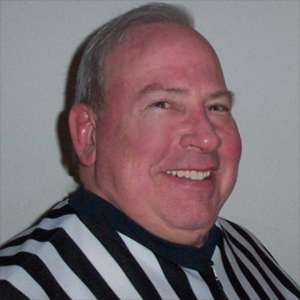
Rndballref
20 Years Experience
Chicago, IL
Male, 60
For twenty years I officiated high school, AAU and park district basketball games, retiring recently. For a few officiating is the focus of their occupation, while for most working as an umpire or basketball referee is an avocation. I started ref'ing to earn beer money during college, but it became a great way to stay connected to the best sports game in the universe. As a spinoff, I wrote a sports-thriller novel loosely based on my referee experiences titled, Advantage Disadvantage
A defender has every right to hold his ground as long as he obtains the position legally. He has NO obligation to give ground or soften a collision once he obtains initial legal guarding position.
Share Answer: 

see answer above.
Share Answer: 
Was it the Michigan State player? If it is the play I was looking at it was a close call, but I probably would have called traveling.
So here is the play: A player catches the ball with both feet in the air. Going backwards the left foot comes down first (it will be the pivot). Then the right foot comes down beyond the 3 point arc. He lifts the left (pivot) foot. At this point he is ok if he alights or stays on the right foot and then passes or shoots. As soon as his left foot touches the floor or he hops on his right it is traveling.
Share Answer: 
OK, here is what I saw. He gets the ball while both feet are planted. So either foot can be the pivot foot. He lifts up his left foot which makes his right foot his pivot foot. he then steps onto his left foot and lifts his right foot. At this point he cannot move or slide his left foot nor can he touch the right foot on the floor. From here he must shoot or pass. Looks to me like a legitimate basketball move and no violation.
It is hard to understand this fact about traveling: it is not illegal to lift your pivot foot per se. If you could not lift your pivot foot how could you ever shoot a traditional layup?
Share Answer: 
Radio program/music director
 Just how good of a radio host do you think Howard Stern is?
Subway Store Manager
 Is Subway viewed as a healthy fast food option in Australia?
REALTOR®
 What's the best way to know if housing prices are going to rise or fall?
In the NBA rulebook team possession ends when there is a legal field goal attempt OR the opponent gains possession. So until the defenders gain possession the 24 second clock keeps ticking.
Share Answer: 
Why couldn't he pick up the ball? Even after a dribble, a player can fumble the ball and recover it as long as it is accidental and there is no purposeful dribble. Having said that:
A player can box out anywhere on the court as long as he moves to a spot before the opposite team player moves toward that spot.
Share Answer: 
Most instructors will tell you that indicating a spot or a runner throw in to both the offense and defense is good, solid preventative officiating so that if there is a thrown violation neither team can complain about a misunderstanding.
To my knowledge this mechanic is NOT in the official's manual.
Share Answer: 
-OR-
 Login with Facebook
 (max 20 characters - letters, numbers, and underscores only. Note that your username is private, and you have the option to choose an alias when asking questions or hosting a Q&A.)
(A valid e-mail address is required. Your e-mail will not be shared with anyone.)
(min 5 characters)
By checking this box, you acknowledge that you have read and agree to Jobstr.com’s Terms and Privacy Policy.
-OR-
Register with Facebook(Don't worry: you'll be able to choose an alias when asking questions or hosting a Q&A.)



 Browse Jobs
 Host a Q&A
 Search

 Submit Your Question
 Host a Q&A
 Last 7

