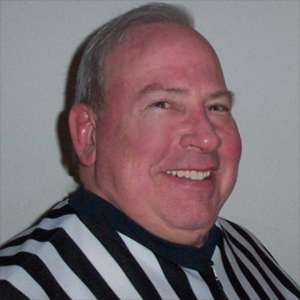
Rndballref
20 Years Experience
Chicago, IL
Male, 60
For twenty years I officiated high school, AAU and park district basketball games, retiring recently. For a few officiating is the focus of their occupation, while for most working as an umpire or basketball referee is an avocation. I started ref'ing to earn beer money during college, but it became a great way to stay connected to the best sports game in the universe. As a spinoff, I wrote a sports-thriller novel loosely based on my referee experiences titled, Advantage Disadvantage
Well, in basketball size matters. So do skills. There sre always smaller guards playing at high school, college and pros but at that size you must be quick, and handle the ball well.
Having said that, if you love the game there is always a place to play (intramurals, house leagues, etc.). When i was.in college there was a university intramural league for players 5'9".and under. A guy in my dorm dominated the league ... he was 5'8", could drive to the basket, play the post and dunk. So if you love the game find a place where you can play.
Share Answer: 

Are you nervous playing organized basketball? The way to calm your nerves and to hone your skills is to play basketball against similar age/skills outside in a park where you just play for fun. That experience transfers to organized games.
Share Answer: 
The travelling rules are built around your pivot foot. If you have a pivot foot, you can step with the other foot and lift your pivot but it is travelling if your pivot foot touches the floor after lifting it, it is travelling. As far as the three point goes, your position is where your feet were when you jumped. So if a foot is touching the line when you jump it is a try for 2.
Share Answer: 
The rulebook says that the count starts when the ball is at the throw in team's disposal.
Share Answer: 
Subway Store Manager
 What do you think is the healthiest option on the Subway menu?
Private Detective
 Has anyone ever caught you surveilling them, and what happened?
Call Center Employee (Retail)
 What's the meanest thing someone's said to you on the phone?
No, you never are awarded free throws for player control fouls.
Share Answer: 
If player b stepped in first it is a delayed violation and player a is awarded another throw. If player b did not step in before it was clear the ball would not touch the ring then no violation. The answer to your question is entirely bssed on whether b violated. If b did not violate, then b gets the ball. If b violated then a gets another free throw, regardless of whether the free throw is an air ball.
Share Answer: 
At a point nearest to the violation.
Share Answer: 
-OR-
 Login with Facebook
 (max 20 characters - letters, numbers, and underscores only. Note that your username is private, and you have the option to choose an alias when asking questions or hosting a Q&A.)
(A valid e-mail address is required. Your e-mail will not be shared with anyone.)
(min 5 characters)
By checking this box, you acknowledge that you have read and agree to Jobstr.com’s Terms and Privacy Policy.
-OR-
Register with Facebook(Don't worry: you'll be able to choose an alias when asking questions or hosting a Q&A.)



 Browse Jobs
 Host a Q&A
 Search

 Submit Your Question
 Host a Q&A
 Last 7

