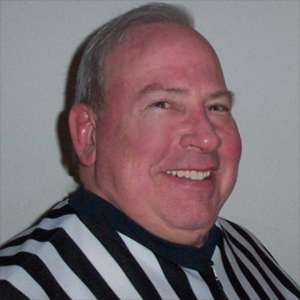
Rndballref
20 Years Experience
Chicago, IL
Male, 60
For twenty years I officiated high school, AAU and park district basketball games, retiring recently. For a few officiating is the focus of their occupation, while for most working as an umpire or basketball referee is an avocation. I started ref'ing to earn beer money during college, but it became a great way to stay connected to the best sports game in the universe. As a spinoff, I wrote a sports-thriller novel loosely based on my referee experiences titled, Advantage Disadvantage
The ball is always awarded to the team opposite of the one who touches the ball last. The rim or backboard does not erase the last person to touch the ball. So in your question the defensive player is the last to touch the ball (ever so slightly) and the ball goes back to the shooter's team.
Share Answer: 

Placing the ball on the floor repeatedly denies the other team the opportunity to grab the ball and run. Here's how it should be handled. After the second occurence, the ref should stop the game and issue a "delay of game warning" against the team, and ask the scorer to register a warning in the book.. If they do it again, the offending player should be charged with a technical foul.
Share Answer: 
There is no provision in the rules for an official to overrule another, and there is no prohibition against it. One of the officials is designated as the referee, the others are umpire 1 and umpire 2. The referee has to settle all disputes not envisioned by the rule book. As I have said before, I always wanted my partners to approach me if they disagreed with my call and allow me to change my own call if my partner created doubt or if they clarified the play for me. But I always wanted the right to not change my call as well. By the original caller changing his call he can explain it to the coach adversely affected. Good referees have this discussion before the game and talk about how they are going to handle a disagreement on a call. Generally, this should not happen too often because each referee has a specific area to watch and while there is some overlap calls usually fall within one ref's primary responsibility area.
Share Answer: 
The simple answer is that if the contact you are describing is material it should definitely be called a foul. A defender can use such contact to hold an opponent or to indicate which way a play will go (which is why handchecks need to be called more often).
Share Answer: 
Pharmaceutical Researcher
 Is there or isn't there a cure for AIDS?
Professional Reseller
 What kind of mark-ups can you fetch on the clothing you resell from thrift stores?
Call Center Employee (Retail)
 What's the craziest unprofessional-phone-rep story you've ever heard?
OK. Got it. A player with the ball could push, hold, slap, trip, and charge for player control fouls. A team mate of the player with the ball could do the same plus illegal screens. All of these are control fouls with no free throws.
Share Answer: 
In a local baseball league, they implemented a rule that if a player or parent was tossed from a game, the player was ruled ineligible until the parent umpired a game at his/her level of choice. The league has a handful of letters of apology from parents who tried (quite unsuccessfully) to umpire games.
If I might be so bold as to suggest that you become patched for basketball in your state, attend summer camp to get trained, and work some games next year. You will gain a better understanding of the game, probably help your daughter's game and you will watch her play a little calmer.
Share Answer: 
According to theriches.com beginning NBA referees make $150,000 and senior officials make up to $550,000. In every game, one official is designated as the "referee" and the others are "officials". In NFHS, the referee has certain additional duties such as picking who will toss jump balls, giving pre-game instructions etc.. But the "referee" is not supposed to overrule the other two officials. I suspect that in the NBA, senior officials might have additional duties such as travel arrangements, meetings, training, rule advisories, etc.
Share Answer: 
-OR-
 Login with Facebook
 (max 20 characters - letters, numbers, and underscores only. Note that your username is private, and you have the option to choose an alias when asking questions or hosting a Q&A.)
(A valid e-mail address is required. Your e-mail will not be shared with anyone.)
(min 5 characters)
By checking this box, you acknowledge that you have read and agree to Jobstr.com’s Terms and Privacy Policy.
-OR-
Register with Facebook(Don't worry: you'll be able to choose an alias when asking questions or hosting a Q&A.)



 Browse Jobs
 Host a Q&A
 Search

 Submit Your Question
 Host a Q&A
 Last 7

