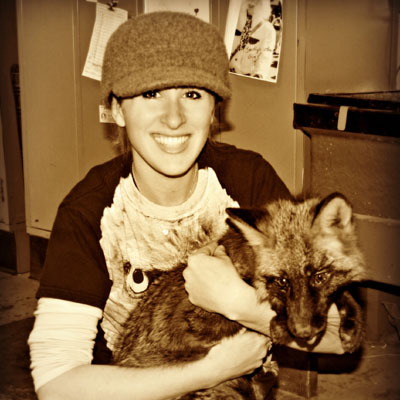
LisaAnnOKane
Tampa, FL
Female, 32


During my zookeeping and environmental education career, I have interacted and worked with a variety of animals, including brown bears, wolverines, red foxes, moose, camels, mountain goats, dolphins, sea lions, raccoons, porcupines, snakes, raptors and ravens. I am also a young adult author, and my debut novel ESSENCE was released in June 2014 by Strange Chemistry Books. Ask me anything!
Hi Jill! This is a great question. I think the first step is definitely establishing realistic expectations for each particular animal. (A domestic camel, for example, is going to initially be much more apt for enthusiastic interactions than a mountain goat.) You can research other zoo's behavioral plans to see what worked and what didn't work for them, and you can also do your homework and take a look at each animal's natural history to get a clue how it will respond to your presence.
Once you have established a basic plan for your interactions with your new animal, your next step will be to be consistent--and patient! Successful interactions, connections, and relationships vary widely between species and individual animals, and there is no magic number for how quickly or slowly these relationships will develop.
To make things even more complicated, sometimes an animal will NEVER respond to you the way you think it should. In my experience, individual animals have demonstrated preferences for certain keepers versus others in ways that defied logic. Maybe it's your smell, maybe it's the sound of your voice... No matter what you do, some animals just aren't going to connect with you. That's why it's so important to keep an open mind--and to pay strict attention to what your animal is actually telling you, not just what you think it should be telling you.
At the end of the day, it's exciting to witness which ones you connect with versus which ones you really don't. Sometimes, they surprise you!
Share Answer: 

Hi Kidbear! I have interacted with orphaned brown bear cubs without barriers or sedatives, but I have never interacted with adult bears or big cats without these safety precautions. All of my facilities have always had strict procedures in place to minimize accidents and injuries, so these types of interactions were never allowed.
Share Answer: 
Hi Laura! Most for-profit organizations are not allowed to have volunteers, so your best bet would be to look for a non-profit zoo/aquarium in the Orlando area. Off the top of my head, I know the Central Florida Zoo & Botanical Gardens in Sanford accepts volunteers. I would recommend visiiting their website to see what their specific requirements are. Best of luck to you!
Share Answer: 
Hi again, Bulldogs! It often takes an animal a little while to adjust to its new environment, so zookeepers are very patient. They also take great care to make the environment as "interesting" as possible so the animal has many opportunities for mental and physical stimulation.
If it seems like an animal isn't responding well to its environment, they will work hard to adapt their behavioral management plans to provide new opportunities for the animal. They may even combine certain species together (if possible) to provide companionship if the animal is the only one of its kind.
If these methods still don't work, zoos may begin to consider transferring the animal to another facility where they think it may be more successful. They won't rest until they find a solution!
Share Answer: 
Hairstylist and Makeup Artist
 How much am I supposed to tip my hairstylist?
Magician
 What's the most amazing magic trick you've ever seen?
Toll Collector
 Do you think there will be a time where all tolls are automated?
Great question, CAT! Primate enrichment programs—like any other animal enrichment programs—are designed to enhance a particular animal’s behavioral, physical, social, cognitive and psychological well being. Enrichment is of particular importance to very complex animals like primates, because they require a great deal of physical, mental and social stimulation.
The first step in designing an enrichment program for a primate is to research that species’ natural behaviors and physiology. Once you have a handle on what the animal “likes to do,” the next step is to design a goal-oriented plan that identifies the species-specific behaviors are desired from that animal (digging, nesting, etc.).
In the case of large primates, structural enrichment and object enrichment are used quite often in enrichment plans. Artificial trees, platforms, hammocks, hoses and rope provide opportunities for decision making—and so do novel items like crates, balls, food items, barrels, burlap sacks, boxes, etc.
It is important to provide enrichment items at variable intervals to prevent animal boredom. It is also important to provide social enrichment in the form of companionship with other animals, training sessions and bonding time with trainers.
Enrichment plans must include how the enrichment will be developed, how it will ensure the animal’s safety, and how it will be monitored to document the animal’s response to it. (Interns and/or volunteers usually do the majority of monitoring.)
Understanding that many animals often require a “breaking in period” where they size up new additions to their environment, trainers should make sure to keep detailed records to ensure the animal eventually utilizes and is stimulated by the enrichment provided.
Hope this helps!
Share Answer: 
This obviously varies quite a bit from animal to animal, but our typical tools of the trade are treats, kennels, hand nets of various sizes, animal control nets, mesh nets, poles, squeeze cages, fog horns, fire extinguishers, tranquilizer darts, and even firearms for the most serious circumstances.
Share Answer: 
Hi Lynnski, and thanks so much for your question. Zookeeping is a very rewarding and unique career, but be forewarned that it also involves very long hours and relatively low pay. The good news is that the vast majority of people who become zookeepers do so for the right reason--because they love it and can't see themselves doing anything else. However, the compensation and long hours do require a lifestyle sacrifice, so make sure you weigh this cost when deciding if this career is right for you.
Your animals don't care if it's day or night, raining or snowing, a weekend or a holiday. They still need to eat, and they still need medical attention. Sometimes this means you have to miss holiday dinners, stay overnight, stand in freezing pools for hours, or run right into a disaster like an earthquake or a hurricane while everyone else is running out.
The upside: you get to build a bond with an animal most people only dream of ever seeing in real life. And some of your animals begin looking forward to seeing you almost as much as you look forward to seeing them. That kind of compensation can't really be quantified. ;)
As far as your question about starting your career, I would recommend looking at this article from the American Association of Zookeepers: "So, You Want to Be a Zoo Keeper, Trainer, or an Aquarist?" (http://aazk.org/wp-content/uploads/keeper_information.pdf).
If zookeeping still feels like a good fit for you, I would encourage you to check out the Association of Zoos and Aquariums' Job Listing page: http://www.aza.org/joblistings/
Best of luck!
Share Answer: 
-OR-
 Login with Facebook
 (max 20 characters - letters, numbers, and underscores only. Note that your username is private, and you have the option to choose an alias when asking questions or hosting a Q&A.)
(A valid e-mail address is required. Your e-mail will not be shared with anyone.)
(min 5 characters)
By checking this box, you acknowledge that you have read and agree to Jobstr.com’s Terms and Privacy Policy.
-OR-
Register with Facebook(Don't worry: you'll be able to choose an alias when asking questions or hosting a Q&A.)



 Browse Jobs
 Host a Q&A
 Search

 Submit Your Question
 Host a Q&A
 Last 7

