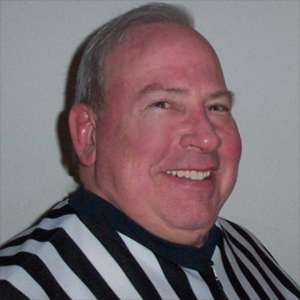
Rndballref
20 Years Experience
Chicago, IL
Male, 60
For twenty years I officiated high school, AAU and park district basketball games, retiring recently. For a few officiating is the focus of their occupation, while for most working as an umpire or basketball referee is an avocation. I started ref'ing to earn beer money during college, but it became a great way to stay connected to the best sports game in the universe. As a spinoff, I wrote a sports-thriller novel loosely based on my referee experiences titled, Advantage Disadvantage
Sir, thank you for your service! The answer to your question lies in a simple rule of thumb: administer fouls in the order they occurred. So, clear the lane, let the original player shoot his free throws or one and one. Then, the same team can choose any player on the floor to shoot the technicals, then award the ball at half court for the same team.
Share Answer: 

If I thought that it was a legitimate attempt at a time out, or if it happens the first time then I would ignore the request. If I thought the coach was purposely trying to interfere with the ordinary flow of the game by asking for a time out without possession then I would call an unsportsmanlike technical.
Share Answer: 
I do not know. Each state association sets rules for eligibility so you will have to check with Indiana's high school association.
Share Answer: 
No violation. Normally, an airborne player is considered to be from the court position where he was when he jumped. So, in your example, Player B jumps from his front court, catches the ball and lands in his backcourt (partially), This would normally be a violation. However there are two situations where this principle does not apply. 1) either team on a throw in, and 2) a defensive player intercepting a pass (exactly your scenario). No violation because of exception # 2. Play on.
Share Answer: 
Small Website Owner
 What made you go the entrepreneur route after college instead of a typical job?
Rap Promoter / Manager
 Do rappers ever stage beefs with each other as a PR stunt?
Flight Attendant
 What kinds of passengers annoy you the most?
In NFHS rules, a shooter can retrieve an airball shot before any other player touches the ball as long as the shot was a legitimate try.
Share Answer: 
I am not an expert on AAU rules but common sense would tell anyone to avoid officiating your son's game in competitive play. It would be different if it was a "house" league, but this is inappropriate for traveling basketball.
Share Answer: 
A single flagrant foul results in a disqualification in NFHS rules.
Share Answer: 
-OR-
 Login with Facebook
 (max 20 characters - letters, numbers, and underscores only. Note that your username is private, and you have the option to choose an alias when asking questions or hosting a Q&A.)
(A valid e-mail address is required. Your e-mail will not be shared with anyone.)
(min 5 characters)
By checking this box, you acknowledge that you have read and agree to Jobstr.com’s Terms and Privacy Policy.
-OR-
Register with Facebook(Don't worry: you'll be able to choose an alias when asking questions or hosting a Q&A.)



 Browse Jobs
 Host a Q&A
 Search

 Submit Your Question
 Host a Q&A
 Last 7

