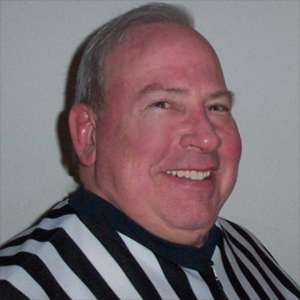
Rndballref
20 Years Experience
Chicago, IL
Male, 60
For twenty years I officiated high school, AAU and park district basketball games, retiring recently. For a few officiating is the focus of their occupation, while for most working as an umpire or basketball referee is an avocation. I started ref'ing to earn beer money during college, but it became a great way to stay connected to the best sports game in the universe. As a spinoff, I wrote a sports-thriller novel loosely based on my referee experiences titled, Advantage Disadvantage
Team control ends when there is a try or tip, an opponent secures control, or the ball becomes dead. Hitting the hand of player B does not constitute control so I would say if the ball is picked up by team a in the backcourt it is a violation.
Share Answer: 

If the player controlled the pass and purposely knocked the ball down, then it began his dribble. If the player reached out to catch the ball and the ball fell to the ground, then it is a muff and did not start the dribble. It is a judgement call by the official.
Share Answer: 
Sounds like you are getting a late start but I would never discourage anyone from pursuing their dream. By the way, Michael Jordan was cut from his high school team and clearly he stuck to it.
Share Answer: 
If two fouls of the same kind occur simultaneously by opposite teams the free throws offset and are not shot. In your example the fouls are different and are administered as they occurred. So clear the lanes, shoot the one and one. Go to the other end and shoot the 2 Ts. Ball out of bounds at half court.
Share Answer: 
Antiques Dealer
 Does a piece's value increase significantly if it has a cool "back-story" to go along with it?
Swim Instructor
 Is it easier to learn to swim as a child or adult?
Casino Dealer
 Do you find casinos to be depressing places to work?
Yes. A sub can be brought in on any dead ball when the clock is stopped. The only exception is if there is to be another free throw after this one subs are to wait until the next to last free throw before being waved in.
Share Answer: 
Yes as long as the shot leaves the shooter's hand before time expires.
Share Answer: 
A player is allowed to fumble the ball after gaining possession, and then dribble if he has not dribbled heretofore. BUT, the fumble has to be unintentional in the eyes of the official.
Share Answer: 
-OR-
 Login with Facebook
 (max 20 characters - letters, numbers, and underscores only. Note that your username is private, and you have the option to choose an alias when asking questions or hosting a Q&A.)
(A valid e-mail address is required. Your e-mail will not be shared with anyone.)
(min 5 characters)
By checking this box, you acknowledge that you have read and agree to Jobstr.com’s Terms and Privacy Policy.
-OR-
Register with Facebook(Don't worry: you'll be able to choose an alias when asking questions or hosting a Q&A.)



 Browse Jobs
 Host a Q&A
 Search

 Submit Your Question
 Host a Q&A
 Last 7

