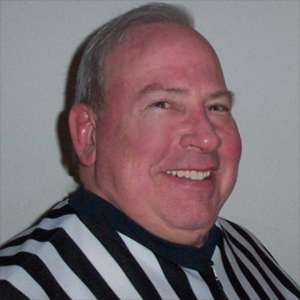
Rndballref
20 Years Experience
Chicago, IL
Male, 60
For twenty years I officiated high school, AAU and park district basketball games, retiring recently. For a few officiating is the focus of their occupation, while for most working as an umpire or basketball referee is an avocation. I started ref'ing to earn beer money during college, but it became a great way to stay connected to the best sports game in the universe. As a spinoff, I wrote a sports-thriller novel loosely based on my referee experiences titled, Advantage Disadvantage
A try or tap ends when it is apparent that the ball will not go through the ring. So when a 3 point try falls short and the ball bounces on the floor the try is over. When a ball enters the ring and goes through (assuming it is no longer a 3 point try) it is a two point score.
Share Answer: 

I think the end of close game calls are debatable, especially by the coaches who have a vested interest. From the beginning, I have been confident enough to be strong in my calls and my judgement. Here's what happened in one instance: The lead changed hands 3 times in the last minute. With 3 seconds left and the game tied, I am administering a throw in to the home team near their basket on the end line. After a time out, the home team lobs over the defender and the offensive player skips toward the basket after dribbling once and picking up the ball. I blow met whistle loudly while the ball is in the air, and I am waiving off the shot (the buzzer sounds while the ball is in the air as well). I move in and call traveling and I am waiving off the shot, sending the game into overtime. The home coach just stared at me during most of the 1 minute period before overtime. In overtime the visitors pulled away and won the game, much to the chagrin of the home team. Two years later, the home coach was scouting a state playoff game I was working and at halftime said to me, "that was the most courageous and correct call in a critical moment that he had seen". The coach said that he asked the assignment chairman to put me on more of his games. I think he watched the tape and saw the traveling. In summary, I have made a few calls I regret, but none of them have been mistakes at crucial times.
Share Answer: 
Some international games are played without referees touching the ball on violations, as you suggest. I guess it rewards readiness but also creates a sneakiness to the game. As it is played in high school federation rules, the referees should hold the ball allowing substitutes and the teams are given time to setup. I suppose it is a matter of preference.
Share Answer: 
Most respectful way is to ask the ref if he can discuss a play. If you are the kind of coach who is shilling for every call you will be ignored by a skilled official for your own good. You would do well to expend your enegy in understanding how tight or loose a ref is calling a game, and coaching accordingly, rather than ratcheting up your complaints. During a game, the ref holds all the cards. After the game if you feel a ref is grossly misinterpreting the rules talk to the assignment chairman.
Share Answer: 
Sr. Software Engineer
 Is it basically impossible for a skilled programmer to be out of work these days?
Antiques Dealer
 How easy is it to forge a rare piece, and are fakes a big problem in the antiquing world?
iPhone & iPad Technician
 Is Apple is still the young and hip brand or have mom and dad spoiled it?
Replay IS being used by various levels in basketball. In National Federation of High School Rules, states are allowed the option to use replay in the state tournament for specific things such as whether a buzzer shot was launched before time expired. In college, they use replay to ascertain the severity of fouls - whether a tech foul is flagarant or class 1, etc. NBA seems to use it more. The benefit is to make sure you get the call correct, the obvious downside is that it takes time and breaks momentum.
Share Answer: 
The ball is dead when it is apparent to the referee that it will not hit the rim or enter the ring. I wouldn't think that any reasonable official would whistle a lane violation, ruling that it occurred before the free throw was dead. I have never seen it, and if one of my partners called that it would seem like he is trying to pick a fight or punish one team. The only exception would be if the other team steps into the lane (well before the shot is launched) to purposely disconcert the free thrower and he fires an air ball, then I suppose a violation could be called.
Share Answer: 
A player throwing the ball in on a spot throw in is restricted to a 3 foot wide, and unlimited deep area. At least one foot must be in or on this area. There is no travelling possible on a throw in. Now, to your question, a throw in player is allowed to dribble as long as the dribbling is out of bounds. Hypothetically if the throw in player dribles in bounds and then touches the ball it is a turnover because the throw in player was out of bounds and touched the ball which was put in bounds when the dribble hit the playing floor. If the throw in is after a basket, of course there is no 3 foot wide area.
Share Answer: 
-OR-
 Login with Facebook
 (max 20 characters - letters, numbers, and underscores only. Note that your username is private, and you have the option to choose an alias when asking questions or hosting a Q&A.)
(A valid e-mail address is required. Your e-mail will not be shared with anyone.)
(min 5 characters)
By checking this box, you acknowledge that you have read and agree to Jobstr.com’s Terms and Privacy Policy.
-OR-
Register with Facebook(Don't worry: you'll be able to choose an alias when asking questions or hosting a Q&A.)



 Browse Jobs
 Host a Q&A
 Search

 Submit Your Question
 Host a Q&A
 Last 7

